Discover Ideal Dining Room Sets With Hutch In Norwich

You know the feeling. The dining room works well enough most of the year, then one holiday meal, birthday dinner, or Sunday breakfast with the whole family makes every weakness obvious. Plates are stacked in the kitchen, serving pieces are jammed into random cabinets, and the room never quite feels finished.
That's why dining room sets with hutch still matter. They solve two problems at once. They give the room a visual anchor, and they give you honest storage where you need it. In a New England home, where rooms often have to work hard and look good doing it, that combination still makes sense.
Families around Norwich have been trying to solve that same puzzle for generations. Since 1936, Gorins has helped Eastern CT homeowners create dining spaces that feel warm, useful, and pulled together. If you're trying to make your dining room more welcoming before the next round of gatherings, their holiday hosting guide for Eastern CT homes is a smart place to start.
Creating a Heart for Your Home's Gatherings
A Norwich colonial or a farmhouse outside Plainfield usually gives you one clear shot to make the dining room work. The space is often separate from the kitchen, storage is limited, and once guests arrive, nobody wants to spend the whole night walking back and forth for platters, glasses, or extra napkins. A hutch set fixes that problem better than a bare table ever will.
I recommend a hutch when you want the room to pull its weight year-round, not just on holidays. The table handles the meal. The hutch handles the house. It gives you one dependable place for serving pieces, table linens, candles, glassware, and the items that always seem to disappear right before company comes over.
Why this setup still works in real homes
In Eastern CT, many dining rooms are formal enough to be visible from the front hall but practical enough to catch everyday life. That combination is exactly why a hutch keeps earning its place. It finishes the wall, adds storage without asking for another room, and makes the whole space feel settled.
I'll be direct. If you host Thanksgiving in Waterford, birthday dinners in Norwich, or Sunday meals with the grandkids in Lisbon, a hutch is not extra furniture. It is working furniture.
A dining room should help you serve people well and keep the room ready for the next gathering.
A lot of homeowners come in with the same complaint. The table is fine, but the room still feels temporary. There is no proper home for the good dishes, no place to stage dinner, and no single piece that makes the space feel complete. Once they add a well-sized hutch set, the room starts making sense.
That is especially true in older New England homes, where built-in storage is hit or miss and every piece has to earn its footprint. The lower cabinet takes care of the practical clutter. The upper section gives you a place to show the pieces you enjoy seeing, whether that is family china, stoneware, or a few seasonal accents that do not look cheap.
If you are getting the room ready for heavier hosting, Gorins' holiday hosting guide for Eastern CT homes is a useful local resource.
Understanding the Anatomy of a Hutch Set
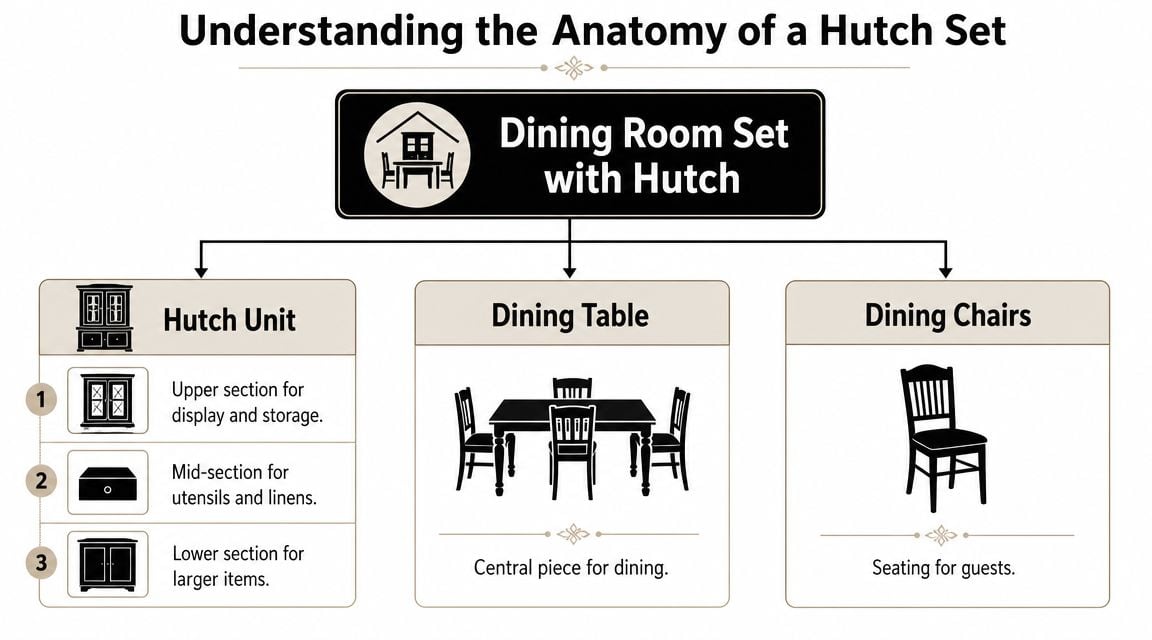
A lot of people use the word “hutch” loosely. Let's clean that up. A true hutch set is a two-part storage and display system. The lower section is usually a buffet or sideboard. The upper section is the hutch itself.
That's why I call it the command center of the dining room. It gives you a work surface, hidden storage, and vertical display in one wall piece.
The lower half does the heavy lifting
The buffet or sideboard base is the practical part. It gives you countertop space for serving food, setting out drinks, or staging dishes before dinner hits the table. Inside, you get concealed storage for the pieces that make a dining room run properly.
Here's what I typically tell shoppers to store below:
- Everyday dinnerware so you're not crossing the kitchen every five minutes
- Table linens that need to stay clean and easy to grab
- Serving pieces like platters, bowls, and trays
- Candles and seasonal extras you don't want cluttering the tabletop
The upper half shapes the room
The hutch top adds vertical storage or enclosed display space. That can mean shelves, glass doors, solid doors, drawers, or built-in lighting depending on the design. According to buying guidance from DutchCrafters on designing a new hutch or buffet, sizing should come first because the footprint and wall height can create circulation problems if you don't measure carefully.
That advice is exactly right. People get distracted by finishes and hardware. They should start with fit.
If you want a deeper look at how a hutch differs from a buffet, sideboard, or other dining storage piece, Gorins has a useful guide on selecting the right dining storage piece for your room.
What separates a hutch from other dining storage
Not every storage piece should be a hutch. Sometimes a buffet-only option is smarter. Here's the clean breakdown:
| Piece | Main job | Best use |
|---|---|---|
| Hutch | Storage plus vertical display | Dining rooms that need presence and organization |
| Buffet | Low storage with serving surface | Rooms with less wall height or a lighter visual need |
| Sideboard | Similar to buffet, often style-led | Flexible storage in dining or adjacent spaces |
Practical rule: If you need the wall to work harder, go hutch. If the room already feels tight, start by asking whether a buffet alone would do the job.
Choosing Your Style and Investment-Grade Materials
Style matters. But style without build quality gets expensive fast. If you want a dining room set with hutch that still looks right years from now, start with the construction, then choose the look.
The good news is that hutches don't have to feel old-fashioned. You can go classic traditional, modern farmhouse, clean transitional, or something more refined and understated. What matters is that the design fits your house and the material holds up to actual use.
Pick a style that belongs in your home
Here's how I frame the main looks for Eastern CT homes:
- Classic traditional works well in colonials and formal dining rooms. Look for framed doors, richer wood tones, and more detailed moldings.
- Modern farmhouse softens the room. You'll usually see lighter finishes, simpler lines, and a more relaxed feel.
- Transitional is the safest long-term choice for many homeowners. It blends clean silhouettes with enough detail to avoid looking flat.
Brands like Aspen Home often appeal to shoppers who want approachable style with storage focus, while buyers who prioritize long-term feel and construction often gravitate toward names they already trust in other categories, like Flexsteel.
Build quality decides whether it's worth bringing home
For durability, dining sets with hutches are commonly marketed with solid wood or mixed hardwood construction. Countryside Amish Furniture's discussion of dining room table sets with hutches also points buyers toward features like solid hardwood construction, made-to-order production, 2-inch-thick planked tabletops, and included leaves. Those details signal structural mass and longevity.
That's what investment-grade means in plain English. More substance. Better stability. Stronger hardware. Less regret.
Material Comparison for Your Dining Set
| Material | Durability | Value | Best For |
|---|---|---|---|
| Solid hardwood | Strong long-term choice with better resistance to daily wear | Higher upfront investment, better long-term ownership value | Busy households, long-term homeowners, custom orders |
| Mixed hardwood construction | Good balance of strength and cost | Solid value when build quality is good | Families wanting durability without going ultra-custom |
| Hardwood veneers | Can look polished and refined when well-made | Good option when design matters and budget needs flexibility | Style-conscious buyers who still want a furniture-grade look |
| Manufactured wood components | More price-driven than legacy-driven | Works for short-term use, not my first pick for heirloom goals | Temporary spaces or highly budget-led decisions |
If you want to better understand how wood species affect appearance and use, Resurrect Wood Refinishing's guide on cabinet wood is worth reading. It helps homeowners think past color alone and pay attention to grain, hardness, and how a wood behaves over time.
For a more showroom-level explanation of species, finish, and longevity, Gorins also has a helpful article on choosing the right hardwood furniture for long-term style and durability.
How to Measure for a Perfect Fit in Your CT Home
You get the dining set home, and then a common problem shows up. The hutch crowds the doorway, chairs scrape the wall, and the room feels tighter than it did in the showroom. I see this in Eastern CT all the time, especially in older homes around Norwich where dining rooms are rarely simple rectangles.
Measure for daily use, not just for furniture placement. Your room needs space to move, serve dinner, and host people without turning every meal into a shuffle.
The measuring order that prevents headaches
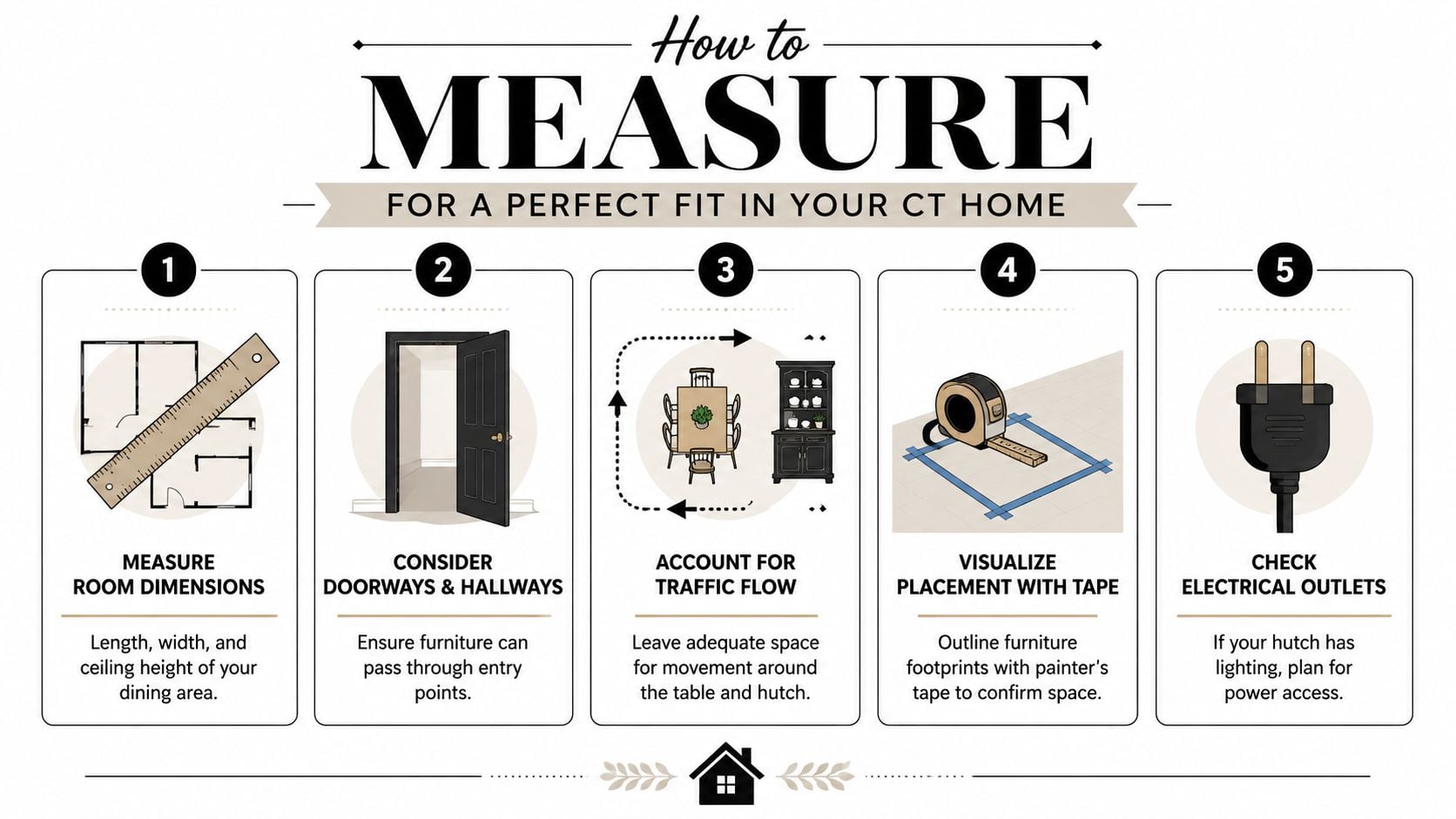
Use painter's tape and follow this order:
Measure the full room
Start with length, width, and ceiling height. In open layouts, decide where the dining area begins and ends so the set does not drift into the kitchen or main traffic lane.Tape out the table footprint
Include the table at full size, plus the room needed for chairs to pull out comfortably. This step stops a lot of bad purchases before they happen.Mark the hutch on the wall
Measure width, height, and depth. Depth matters more than shoppers expect. A hutch that sticks out too far can choke off a walkway fast.Walk the traffic pattern
Leave enough room for someone to pass behind a seated diner without squeezing. If the room only works when nobody is sitting down, the set is too large.Measure the delivery path
Check front doors, stair turns, hallways, and any tight corners. A set can fit the room perfectly and still be a nightmare to bring into a classic New England house.
The size rule I use
For many Connecticut homes with standard ceiling heights, a hutch under 78 inches is a smart checkpoint. It usually keeps the piece in proportion and prevents the room from feeling top-heavy.
Use that as a guide, not a shortcut. Ceiling beams, crown molding, low windows, and uneven floor plans all change what looks right. In older Eastern CT homes, those details matter.
Leave room for the people, not just the furniture.
Small-room advice that saves people from buying the wrong piece
If your dining room is compact, skip the oversized matching suite. Choose a narrower hutch, a buffet-and-topper combination, or a table shape that gives you better circulation. Round and oval tables often solve problems that a big rectangle creates.
I also tell shoppers in Norwich and across Eastern CT to watch wall depth and radiator placement. Those old-house details can limit where a hutch can sit, even when the room looks large enough on paper.
Before you shop, use Gorins' dining table size guide for room proportions and seating space. It's a practical way to narrow your options before you fall for a set that looks great in the store and feels crowded at home.
Designing Your Dream Set with Canadel Custom Dining
If you can't find the right dining room set with hutch off the floor, stop trying to compromise your way into a purchase. In these instances, custom dining offers a practical solution.
A lot of homeowners assume custom means fussy or unrealistic. It doesn't. It means you stop settling for “close enough” on size, finish, chair style, or storage layout.
Why custom is the smarter route
Modern dining collections have shifted toward flexible, coordinated pieces that adapt to different room sizes. Retail guidance also emphasizes checking lighting, electrical outlets, and door swings when placing a custom piece, and anchoring taller hutches to the wall for safety, as noted on Havertys' dining room collections page.
That's one of the big reasons custom works so well. You're not just picking a color. You're building a solution around your room.
Here's what you should expect to customize in a serious program:
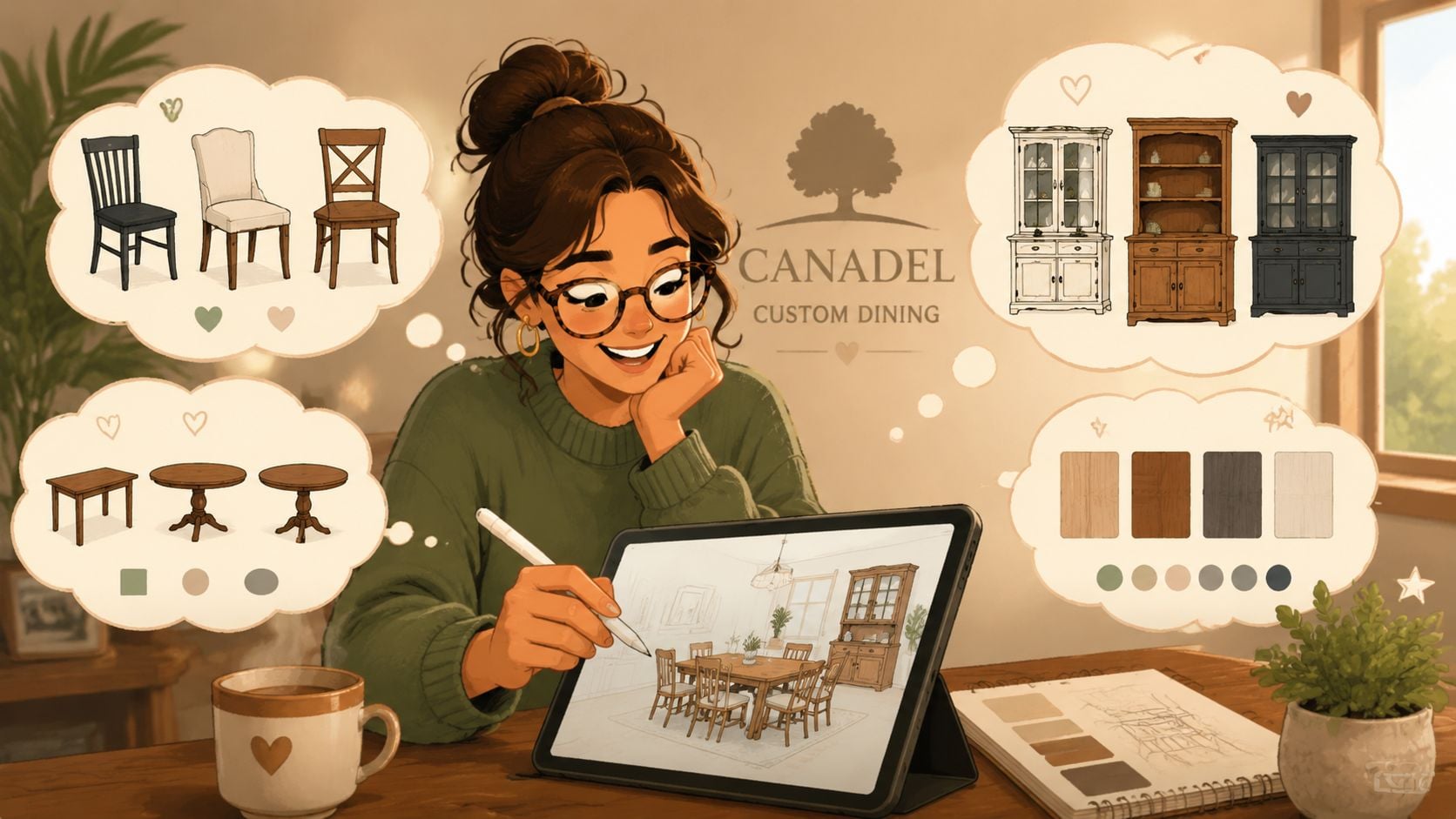
- Table size and shape for the way your room functions
- Chair style based on comfort, look, and how formal you want the room to feel
- Finish color so the piece works with your flooring and trim
- Fabric or seat choice if you want a softer, more refined appearance
- Hutch configuration so storage, display, and scale feel intentional
Why our neighbors in Norwich respond to Canadel
It is Canadel Custom Dining that stands out. It gives homeowners thousands of combinations across sizes, shapes, finishes, and seating details, which is far more useful than wandering from one prebuilt set to another and hoping something clicks.
I'm opinionated on this. If your room has odd dimensions, your home leans specific in style, or you want the piece to stay relevant for years, custom is usually the better investment.
Gorins Furniture & Mattress offers this Canadel custom dining program in Norwich, which gives local shoppers a way to coordinate table, chairs, and storage more precisely than a standard stock set allows. That matters when you're furnishing a real house, not a catalog page.
Custom dining isn't about making things fancy. It's about getting the scale, storage, and finish right the first time.
Styling and Organizing Your New Centerpiece
Once the set is in place, don't treat the hutch like a dumping ground. The room will only feel finished if the storage and display are balanced. The best hutches look lived in, but not overloaded.
I usually tell people to style it in layers of use. Start with what you reach for often. Then add what tells your story.
A simple arrangement that works
Here's an easy way to set up the piece without overthinking it:
- Lower cabinets for the hard-working items like serving bowls, extra plates, tablecloths, and holiday pieces
- Middle drawers for smaller tools such as flatware, candles, matches, and cloth napkins
- Upper shelves for visual anchors like pitchers, heirloom dishes, framed family pieces, or a few books
That setup keeps the practical items near hand while letting the top section do what it should do, which is give the room personality.
What a good before-and-after usually looks like
Before, the room often has too many loose pieces. A stack of platters in one cabinet. Vases in another room. Candles on a crowded shelf. Nothing feels intentional.
After, the hutch pulls those scattered items into one organized zone. White dishes can fill the center shelves. Colored glass or inherited china can sit at the edges. A small lamp or integrated light warms up the display at night. Suddenly the room reads as calm instead of busy.
Don't decorate every inch. Empty space matters. A hutch packed tight from edge to edge looks heavy, even when the furniture itself is beautiful.
Keep the useful pieces closest to hand, and let only a few meaningful objects claim the spotlight.
Seasonal changes are easy too. In fall, maybe a ceramic bowl and darker linens. During the holidays, greenery and candlelight. In spring, lighter pottery and woven textures. The furniture stays steady while the room changes around it.
Bringing Your Investment Home with Gorins
Buying investment-grade furniture should feel reassuring, not chaotic. The product matters, but so does everything around it. Financing, delivery, setup, and follow-through all affect whether the purchase feels smart once the excitement wears off.
That's one reason local buying still has an edge in Eastern CT. You're not just picking something off a screen and hoping a freight company gets it right.
The service side matters more than people think
A hutch set isn't a small-box purchase. It's larger, heavier, and more placement-sensitive than many buyers expect. If the piece includes upper storage, doors, or lighting, proper placement matters even more.
That's also why it helps to read practical moving guidance before delivery day. If you want a good general overview of protecting large household pieces in transit, TLC Moving's Boston guide to shipping household goods gives useful context on preparation and handling.
Make the purchase manageable
For many homeowners, the right piece is worth buying once instead of replacing twice. Promotional Financing with equal monthly payments can make that decision more realistic, especially when you're choosing solid materials or custom work instead of a quick fix.
And don't overlook setup support. White-glove placement and assembly reduce the risk of damage, alignment issues, or a frustrating install once the furniture gets to your house. If you want to see what professional setup can include, Gorins outlines that service on its furniture assembly service page.
Since 1936, Gorins Furniture & Mattress has helped Norwich and Eastern CT families create homes they love. From custom-designed Canadel dining sets to the latest in Tempur-Pedic sleep technology, they combine a massive selection with the personalized care only a local, family-owned business can provide. Visit us today to experience quality, value, and our 5-Star Delivery service.
If you're shopping for dining room sets with hutch in Norwich or anywhere in Eastern CT, visit Gorins Furniture & Mattress to see materials, compare styles, and talk through custom options in person. You can also take the online Style Quiz or browse the Clearance section if you want a value-driven starting point before you buy.