Best Mattress for Allergies: Materials, Care, and Relief


A blocked nose at 3 a.m., itchy eyes before breakfast, and a scratchy throat that settles after leaving the bedroom can make the mattress look guilty. Often, it deserves that suspicion. A bed keeps allergens close to the face for hours, so choosing a mattress for allergies requires more than finding a label that says “hypoallergenic.”
The practical answer is a complete sleep system: the mattress core, an allergen barrier, washable bedding layers, careful cleaning, and controlled bedroom humidity. For Norwich and Eastern Connecticut households, that approach is more useful than treating foam, latex, or springs as a magic solution. The guidance below focuses on measurable allergen thresholds and routines that renters and homeowners can apply without replacing every item in the bedroom.
Why Your Mattress May Be Triggering Nighttime Allergies
A Norwich family may notice the pattern gradually. One person wakes congested, reaches for tissues, and feels better after spending the morning downstairs. Another notices watery eyes only after making the bed. A child may sleep comfortably elsewhere but wake coughing after a night in the same bedroom.
The mattress isn't merely passive furniture in those situations. Over years of use, it can hold dust mite allergens, pet dander, fungal material, and ordinary household dust. Dust mites are a major mattress-related allergy trigger because bedding provides warmth, moisture, and shed skin. The American Lung Association says roughly four out of five U.S. homes have dust mite allergens in at least one bed, while a large housing survey found 46.2% of homes at or above 2.0 µg/g of dust and 24.2% at or above 10.0 µg/g, a level associated with asthma symptoms in sensitized people. The American Lung Association explains the indoor dust mite problem.
Eight hours of close contact turns a moderate reservoir into a repeated nightly exposure. The sleeper's face stays near the pillow, sheets, and upper mattress surface, while movement can disturb fine particles. That doesn't prove the mattress causes every symptom, but it makes the bed a sensible place to investigate first.
Local sleep advice: Treat the bed as a system, not a single product. A suitable core with a poor barrier and damp bedroom can perform worse for allergies than a well-maintained older mattress with effective protection.
People looking for broader bedroom routines can also review this practical guide to sleep better with allergies. Persistent wheezing, breathing difficulty, or symptoms that don't improve with environmental changes warrant medical advice, because dust mites aren't the only possible trigger.
How Dust Mites Colonize a Sleep Surface
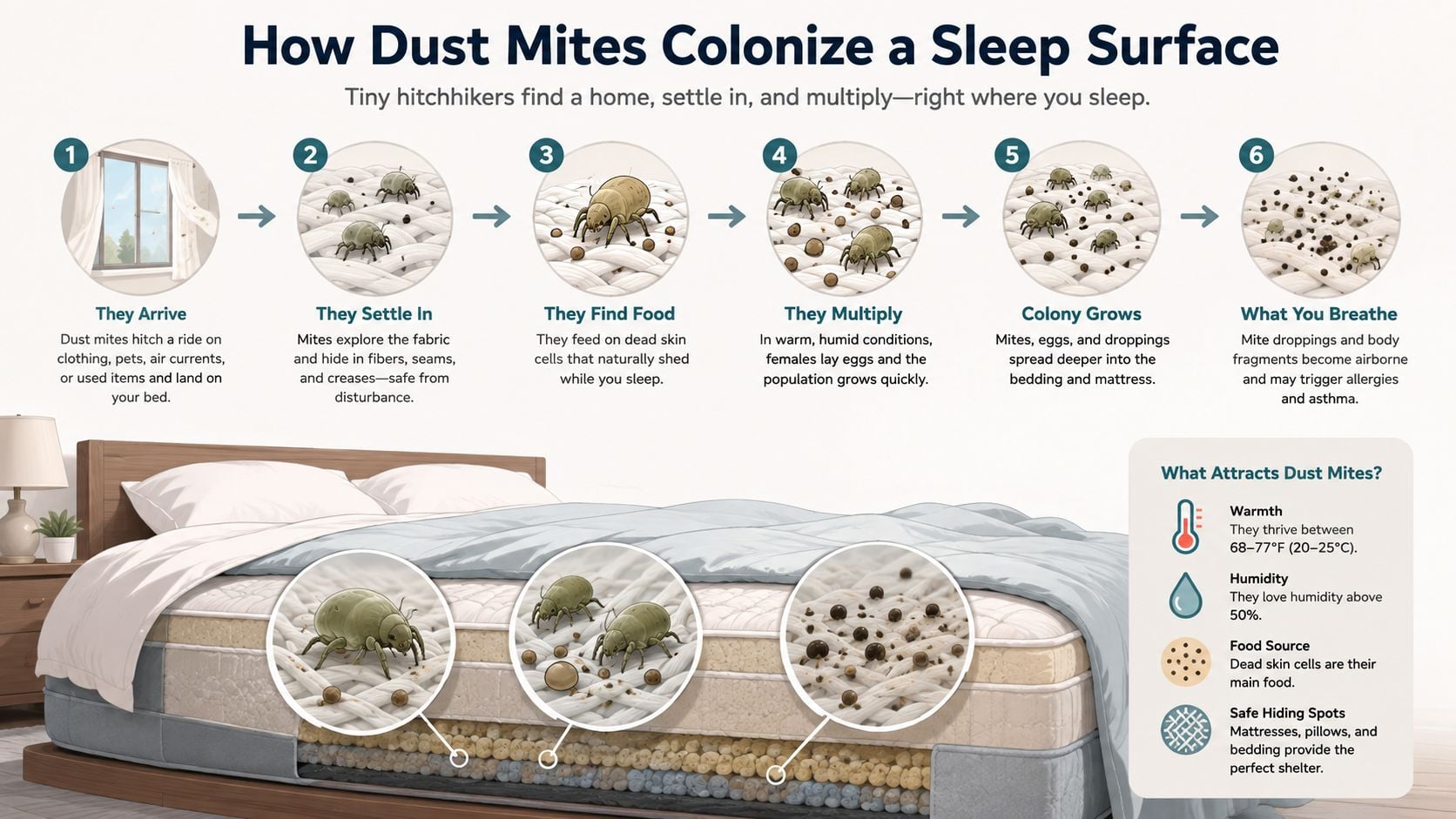
Dust mites, including Dermatophagoides pteronyssinus and D. farinae, feed on shed skin and produce allergen-containing waste. Bedding and mattresses supply both the food source and a protected microenvironment. Humidity matters because the tiny environment inside fabric and padding can differ from the average reading in the room.
The clinical benchmarks are useful, but they shouldn't be treated as a personal diagnosis. A concentration around 2.0 µg/g of dust is a meaningful exposure marker, while 10.0 µg/g is associated with asthma symptoms in sensitized people. The American housing data cited above shows that many beds contain relevant allergen levels, especially where moisture and accumulated dust remain unmanaged.
Why the waste matters more than the mite
Live mites are microscopic, but the major allergic response comes from proteins associated with mite faecal pellets and body fragments. Those particles can become part of mattress dust and move into the breathing zone when bedding is disturbed.
Foam, fibre, and quilted comfort layers can hold dust below the surface. Surface vacuuming removes what the nozzle reaches, but it can't fully extract material embedded deep in a mattress core. That limitation is why an allergen barrier often matters more than a promise about the mattress material itself.
A comparative study found mite faeces in 40.5% of dust samples from uncovered foam mattresses, 26.3% of covered foam mattresses, and 12.5% of spring mattresses. After adjustment, the risk was four times higher in foam than spring mattresses and 8.1 times higher in uncovered foam than in spring mattresses. The comparative clinical study is indexed by PubMed.
Age changes the decision
A new mattress can become a meaningful allergen source in less than four months, so replacement alone isn't a permanent control strategy. Research also found little allergen advantage among foam, spring, and water mattresses, which supports a broader decision based on encasement, bedding, cleaning, and humidity.
For practical upkeep, households can use these mattress maintenance and cleaning tips alongside a realistic inspection of the complete bed. A damp room, unprotected pillow, or dusty bed frame can undermine an otherwise sensible mattress choice.
Comparing Mattress Materials for Allergy Sufferers
No mattress material is allergy-proof. The useful comparison is how each construction handles moisture, dust penetration, cleaning access, and a properly fitted barrier.
Memory foam
Dense memory foam can make it harder for mites to move deep into the core, but the surface still collects skin flakes and dust. Some foam beds also retain body heat, and a warm, damp surface can become uncomfortable if the cover doesn't breathe.
A breathable, washable outer cover and a verified impermeable encasement make memory foam more practical for allergy-conscious sleepers. The core's resistance to penetration helps, but it doesn't remove the need for surface control.
Natural latex
Natural latex is often selected for airflow and resilience. Its structure may be less welcoming to mites than some fibre-rich comfort layers, but latex products vary, especially when they contain blends or synthetic components. A latex sensitivity also makes this category unsuitable for some sleepers, so material comfort and personal tolerance still matter.
Pocket springs
Pocket-sprung mattresses allow airflow through internal spaces, yet their hollow areas and fibre comfort layers can collect dust. Springs don't automatically make a mattress cleaner. A full encasement can reduce transfer from those internal layers, provided the cover fits correctly and remains sealed.
| Material | Mite Resistance | Breathability | Typical Allergen Build-Up Timeline | Encasement Compatibility |
|---|---|---|---|---|
| Memory foam | Better resistance to deep penetration, with surface exposure still possible | Varies by foam and cover | Builds with use if surface dust and moisture remain | Strong, if the encasement accommodates foam depth |
| Natural latex | Potentially less hospitable to mites, but product composition varies | Generally good airflow | Depends on cover, bedding, and humidity | Strong, with a flexible, breathable barrier |
| Pocket springs | Airflow through the unit, but fibre layers and cavities can retain dust | Often good through the spring unit | Depends heavily on comfort layers and protection | Strong, when the cover fully encloses the mattress |
The table is a decision aid, not a guarantee. A household comparing mattresses in Norwich should test comfort by feel, check cover construction, and plan how the bed will be protected after delivery. Regular sheet care also matters, and this guide to how often to change sheets can support the wider routine.
Choosing the Right Allergen-Barrier Encasement
The encasement is the most important accessory for a mattress for allergies. A core can be relatively resistant to dust penetration, but exposed seams, quilting, and fabric still collect particles. A proper barrier separates the sleeper from the mattress dust reservoir.
Clinical testing gives buyers a useful engineering benchmark. Fabrics with pore sizes smaller than 10 micrometres blocked Der f 1 and Der p 1 below detectable limits, while a partial nylon barrier achieved 94% efficacy compared with 66% for regular cotton sheet surfaces. The barrier-fabric study provides the pore-size evidence.
Select the construction before the colour
Choose a six-sided, zippered encasement that surrounds the entire mattress. A fitted protector over the top can guard against spills, but it leaves the sides and underside exposed. Partial protection may still have a role, yet it isn't the same as enclosing the mattress.
Polyurethane-backed cotton can offer a more comfortable balance of softness and moisture management. Vinyl can provide a more impermeable surface but may feel warmer or less flexible. Either way, the product needs a sealed zipper and a fit that doesn't strain the seams.
Avoid common installation mistakes
Measure the mattress depth, including any integrated topper, before buying. Check the zipper track for reinforcement, close it completely, and follow the washing instructions rather than using harsh cycles that can damage the barrier layer.
A washable pad can sit over the encasement to improve comfort and make routine cleaning easier. It should not replace the encasement. Labels such as “hypoallergenic” also shouldn't be accepted without construction details or evidence that the fabric prevents allergen escape.
An encasement trial reduced Der p 1 in mattress dust from 19.2 to 7.2 micrograms per gram of dust, while another trial found reductions by factors of 2.1 for Der p 1 and 2.5 for combined Der p 1 plus Der f 1 after 12 months. The clinical encasement evidence is available through PubMed. For households weighing a protector purchase, this overview of the hidden benefits of a mattress protector offers relevant care context.
Building a Bedroom Environment That Limits Allergens
A mattress doesn't exist in isolation. The pillow, duvet, bed frame, carpet, curtains, and nearby upholstered furniture can all contribute dust to the same breathing zone. A practical bedroom protocol controls moisture first, then limits the amount of settled dust that reaches the bed.
Start with humidity
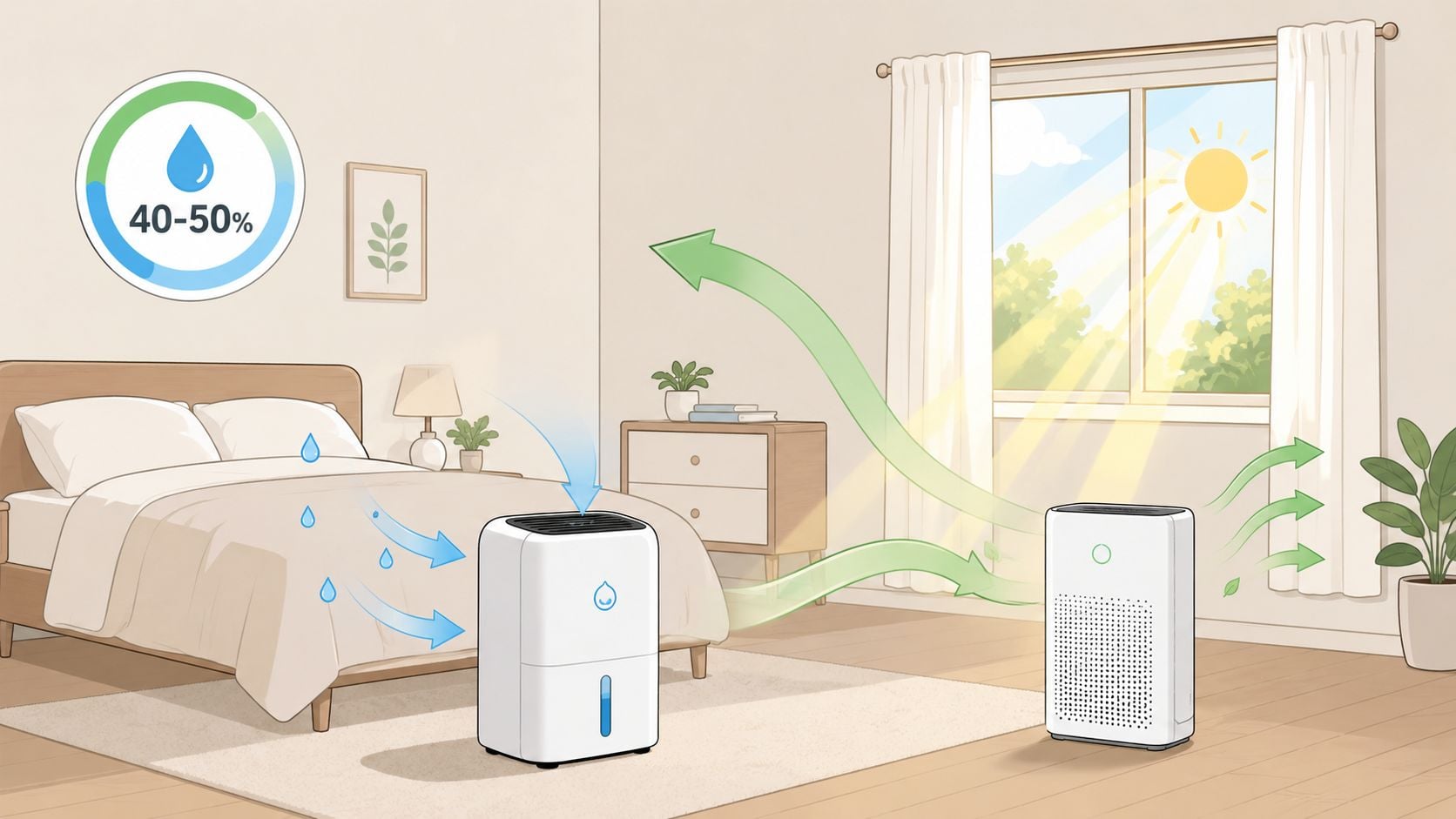
Use a hygrometer rather than guessing. National Jewish Health identifies 30% to 40% as the ideal indoor humidity range, while humidity below 50% is associated with conditions in which dust mites don't survive. A separate review supports maintaining relative humidity between 35% and 50% to decrease mite growth. The humidity review gives the environmental rationale.
Humidity near the bed matters, not just the thermostat reading across the room. A dehumidifier can help in damp bedrooms, especially where condensation, poor ventilation, or a basement location keeps the mattress environment moist. More guidance on practical ways to reduce home allergens can complement a bedroom-specific plan.
Use targeted cleaning
- Bedding: Wash sheets and pillowcases on a consistent schedule, and dry them fully before remaking the bed.
- Mattress surface: Use a bagged vacuum with a HEPA filter before fitting allergy bedding. The dust-mite prevention guidance supports HEPA vacuuming for the mattress.
- Underlayers: Clean the bed frame, headboard, floor around the bed, and any exposed carpet. These areas can reintroduce dust even after the mattress surface is treated.
- Soft furnishings: Keep unnecessary upholstered furniture out of the bedroom and choose washable window coverings where practical.
- Air filtration: A properly sized HEPA air purifier can support airborne-particle control, but it won't replace an encasement or humidity management.
A household can use the dust and allergen-free bedroom maintenance guidance to turn those tasks into a repeatable routine. The strongest result usually comes from several modest controls working together, not from one dramatic cleaning day.
When Lower Allergen Counts Do Not Mean Fewer Symptoms
Reducing allergen on a mattress is worthwhile, but it doesn't guarantee immediate symptom relief. Reviews and trials have found that cleaning, ventilation, and bedding covers can lower dust and allergen concentrations while producing minimal changes in symptoms or quality of life. One large adult asthma trial found no benefit from bed covers alone on morning peak flow, symptoms, or quality of life. The review discusses the gap between exposure reduction and patient outcomes.
That finding changes the recommendation, not the need for sensible protection. An encasement reduces the allergen load at the sleep surface, but the sleeper may still react to pillows, flooring, pet dander, mould, pollen, or uncontrolled humidity.
Read the symptom pattern
A bedroom audit should ask practical questions:
- Do symptoms peak during sleep, on waking, or throughout the day?
- Do they improve outside the bedroom?
- Are pillows, duvets, curtains, or carpets unprotected?
- Does the room feel damp or develop condensation?
- Are wheezing or breathing problems present?
A new bed is less likely to solve the problem if the old pillows remain exposed or the room stays humid. Chronic sinus inflammation and asthma may also require medical management alongside environmental changes. The mattress decision should support that care, not substitute for it.
The most defensible approach combines the encasement, humidity control, washable bedding, and appropriate filtration described earlier. For broader rest habits, households can review these sleep hygiene tips for a better night's sleep without confusing sleep comfort with allergy treatment.
How Gorins Sleep Gallery Supports Allergy-Conscious Shoppers
Gorins Furniture & Mattress has served Norwich since 1936 as a locally owned, family-operated business. In the Sleep Gallery, shoppers can compare Tempur-Pedic, Serta, and Beautyrest mattresses by comfort by feel, while discussing the practical requirements of healthier sleep and allergen control.
The useful conversation isn't limited to “hypoallergenic.” Staff can help shoppers compare foam, latex, and spring constructions, consider cover and encasement fit, and account for bedroom humidity and existing bedding. That matters for Norwich, New London, Plainfield, Waterford, and surrounding Eastern Connecticut and Rhode Island communities, where older housing, coastal moisture, and seasonal changes can affect the complete sleep environment.
A mattress replacement can represent an investment, particularly when the household also needs an encasement and washable layers. Promotional Financing with equal monthly payments can lower the barrier to that investment, subject to applicable approval terms. Shoppers can also use the online Style Quiz or browse Clearance for value-driven savings rather than choosing on price alone.
Gorins' wider showroom includes custom options such as Canadel Custom Dining and the F9 Custom Sofa series, with thousands of combinations for personalized living spaces. The same local-expert approach applies in the Sleep Gallery: identify the household's needs, test comfort by feel, and build a care plan that fits real life.
Since 1936, Gorins Furniture & Mattress has helped Norwich and Eastern CT families create homes they love. From custom-designed Canadel dining sets to the latest in Tempur-Pedic sleep technology, we combine a massive selection with the personalized care only a local, family-owned business can provide. Visit us today to experience quality, value, and our 5-Star Delivery service.
Visit Gorins Furniture & Mattress in Norwich to compare mattress constructions by comfort by feel and discuss an encasement that fits the complete sleep system. The Sleep Gallery team can also help households review Promotional Financing, take the online Style Quiz, or find value-driven options in Clearance.